How to Make AI Writing Sound Human: A Beginner's Guide to Editing AI Content Like a Real Person
In this complete beginner-friendly guide, you'll discover simple techniques that professional writers use to transform robotic AI text into warm, natural, and engaging content. You'll also see dozens of before-and-after examples, real-life case studies, storytelling techniques, human speech patterns, writing formulas,
 Borni Franklin
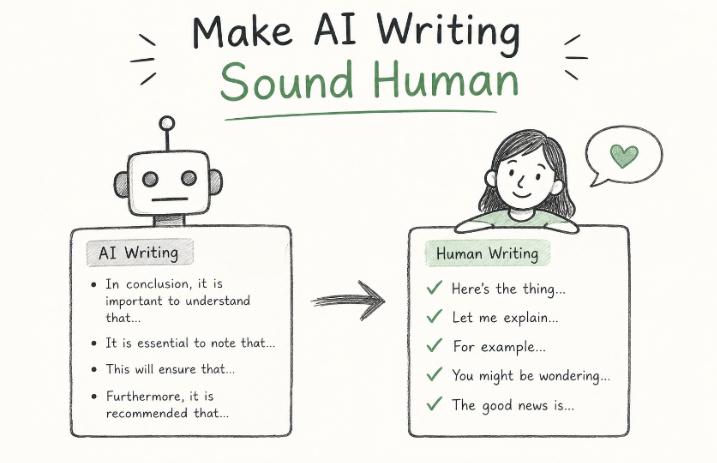
How to Make AI Writing Sound Like a Real Person: The Beginner's Guide to Editing AI Content That People Actually Enjoy Reading
Let's start with something honest.
Have you ever copied something from ChatGPT, Claude, Gemini, or another AI tool, read it back to yourself, and thought,
"It says the right things... but somehow it doesn't sound like a real person."
If that has happened to you, don't worry. You're not the only one.
Millions of people now use AI every single day. Students use it for assignments. Bloggers use it to write articles. Business owners use it to answer emails. Freelancers use it to save time. Even experienced writers sometimes ask AI to help them when they don't know how to begin.
AI has become an amazing helper. It can produce hundreds or even thousands of words in just a few seconds. That would normally take a person several hours.
Sounds wonderful, doesn't it?
Well... yes and no.
The biggest problem isn't that AI gives wrong information. Most of the time it actually gives useful information.
The real problem is how it says it.
AI often sounds like someone reading from a textbook. Every sentence looks perfectly arranged. Every paragraph follows the same pattern. Every idea feels neat and polished.
At first, you might think that's a good thing.
But think about the last conversation you had with your best friend.
Did they speak in perfect paragraphs?
Probably not.
Sometimes they paused.
Sometimes they laughed.
Sometimes they changed the topic before coming back again.
Sometimes they used simple words.
Sometimes they even made little grammar mistakes.
That's what makes people sound human.
Real people have rhythm.
Real people have emotions.
Real people have stories.
AI has information.
People have experiences.
And that's the difference readers notice, even if they can't explain it.
A Small Story Before We Continue
A few months ago, a friend sent me an article he had written with AI. He was excited because it looked professional. It had long paragraphs, perfect grammar, and fancy words.
He asked me one simple question.
"Can you tell me what you think?"
I only read the first two paragraphs before I knew AI had written most of it.
It wasn't because AI is bad.
It was because the article didn't sound like anyone I knew.
There were no personal thoughts.
No little stories.
No questions.
Everything felt... perfect.
Ironically, that perfection made it feel fake.
We spent about twenty minutes editing it together.
We removed some big words. We added a few personal experiences. We asked readers questions. We shortened some sentences and made others longer.
When we finished, it still contained the same information.
But now it sounded like it came from a real person instead of a computer.
Why AI Writing Sounds Robotic
Now let's answer one question that almost everybody asks.
Why does AI writing sound so robotic?
The answer is actually very simple.
AI has never laughed with friends.
It has never been late for work.
It has never forgotten someone's birthday.
It has never sat outside on a rainy evening thinking about life.
It doesn't have memories.
It doesn't have emotions.
Instead, it studies billions of words that people have written on the internet.
Then it predicts what word is most likely to come next.
That's why AI is very good at writing correct sentences.
But being correct isn't the same as sounding human.
Think about a child learning to cook.
The child can read every recipe in the world.
He might know every ingredient.
But until he actually starts cooking, tasting, making mistakes, burning food, and trying again, he won't cook like an experienced chef.
Writing works almost the same way.
Real writers don't just arrange words.
They remember conversations.
They remember mistakes.
They remember funny moments.
Those memories quietly find their way into the words they write.
| AI Usually Does This | Human Writers Usually Do This |
|---|---|
| Uses perfect grammar every time. | Sometimes breaks the rules to sound natural. |
| Writes almost every sentence the same way. | Mixes long thoughts with short ones. |
| Avoids personal opinions. | Shares experiences and personal thoughts. |
| Repeats certain words again and again. | Naturally changes vocabulary. |
| Explains everything perfectly. | Sometimes pauses, asks questions, or tells stories. |
Can you see the difference?
Neither one is necessarily wrong.
But one feels alive.
And that's the one readers remember.
A Little Experiment
Let's try something together.
Read these two paragraphs slowly.
Version One
Regular physical exercise contributes significantly to overall health and wellness while reducing the likelihood of numerous chronic diseases.
Version Two
Here's something I've noticed. On the days I go for even a short walk, I usually feel happier and have more energy. It doesn't have to be an hour at the gym. Sometimes twenty minutes outside is enough to make your whole day feel better.
Both paragraphs are talking about exercise.
Both are correct.
But which one sounds like a real person talking to you?
Most people choose the second one.
Why?
Because it feels like someone has actually lived it.
Readers don't only connect with information.
They connect with people.
That's exactly what we're going to learn throughout this guide.
We're not trying to make AI smarter.
We're learning how to add something AI can never truly have—your own voice, your own experiences, and your own way of talking.
Why Human Writing Feels So Different
Now that you know why AI writing often sounds robotic, let's look at the other side of the story.
What makes human writing so enjoyable to read?
It's actually not because humans always write better.
Believe it or not, real people make plenty of mistakes.
Sometimes we forget a word.
Sometimes we repeat ourselves.
Sometimes we start explaining one thing and end up talking about something completely different before coming back to our original point.
Funny enough, those little imperfections often make writing feel more real.
Imagine you're sitting in a restaurant.
The waiter comes over and says,
"Good evening. I sincerely appreciate your presence at our establishment. Kindly allow me to present today's dining selections."
There's nothing wrong with those words.
But does anyone actually talk like that?
Probably not.
Now imagine another waiter walks over smiling and says,
"Good evening. Welcome! We've got some really nice meals today. Take your time, and if you need any help deciding, just let me know."
Which waiter would make you feel more comfortable?
Most people would choose the second one.
Not because his English is better.
But because he sounds like a normal human being.
Writing works exactly the same way.
| Robotic Writing | Human Writing |
|---|---|
| Focuses only on information. | Focuses on information and connection. |
| Always sounds serious. | Can sound serious, funny, emotional or curious. |
| Rarely asks questions. | Often talks directly to the reader. |
| Uses complicated words. | Uses simple everyday language. |
| Feels distant. | Feels like a conversation. |
Think About Someone You Enjoy Listening To
Maybe it's your grandfather.
Maybe it's your favourite teacher.
Maybe it's someone on YouTube whose videos you never skip.
Why do you enjoy listening to them?
Is it because they use long words?
Probably not.
It's usually because they explain things in a way that makes sense.
They tell stories.
They smile.
They pause.
Sometimes they even laugh at themselves.
That is exactly the feeling you want your writing to create.
Step 1: Read It Out Loud
Now we're going to learn the easiest editing trick in this entire guide.
In fact, if you only remember one lesson after reading this article, I hope it's this one.
Read your writing out loud.
Not inside your head.
Actually say the words.
You might feel a little silly the first time.
That's okay.
Professional writers have been doing this for years.
Why?
Because your ears notice problems that your eyes often miss.
Let me show you what I mean.
Imagine you asked AI to write a paragraph about saving money.
AI Version
Maintaining consistent financial discipline is essential for achieving long-term financial stability and minimizing future economic uncertainties.
Now read that sentence out loud.
Would you ever walk up to your friend and actually say those words?
Probably not.
Now look at this version.
Edited Version
Saving a little money every month can make life much easier. You never know when something unexpected might happen, and having some savings can really help.
Notice the difference?
The second paragraph doesn't try to impress you with big words.
Instead, it tries to help you understand the idea.
That's exactly what good writing should do.
Your Mouth Is a Better Editor Than Your Eyes
Here's something I learned years ago.
When you read silently, your brain quietly fixes mistakes without you even noticing.
It's almost like your brain wants to help the writing sound better.
But when you read every word out loud, your brain can't cheat anymore.
You suddenly hear every awkward sentence.
You notice words repeating.
You notice sentences that are too long.
You notice places where you naturally want to stop and take a breath.
Those little moments tell you exactly where your writing needs editing.
| If You Read It Out Loud... | It Probably Means... |
|---|---|
| You run out of breath. | The sentence is probably too long. |
| You stumble over the words. | The wording feels unnatural. |
| It sounds like a school textbook. | Use simpler words. |
| You get bored while reading. | The paragraph needs more personality. |
| It doesn't sound like something you'd actually say. | Rewrite it in your own voice. |
A Simple Trick That Changed My Writing Forever
Years ago, I used to think good writing meant using impressive words.
Whenever I finished an article, I felt proud because it sounded very professional.
Then one day my older brother looked at something I had written.
He smiled and asked me one question.
"If you were sitting beside me right now, would you actually talk like this?"
I laughed.
Because the answer was no.
Not even close.
That simple question completely changed the way I write.
Today, every time I finish writing, I imagine I'm explaining the same thing to someone sitting beside me.
If it doesn't sound like something I'd actually say in a normal conversation, I edit it until it does.
Believe it or not, this one habit has improved my writing more than any expensive course or fancy software ever did.
And the good news?
You can start using it today.
In the next step, we'll learn another simple trick that instantly makes AI writing sound more human. We'll look at why big words often push readers away and how replacing them with everyday words can completely change the way your writing feels.
Step 2: Stop Trying to Sound Smart
Now let's talk about one of the biggest mistakes almost everyone makes when editing AI content.
They think good writing must sound intelligent.
So they leave all the long words exactly the way AI wrote them.
Let me tell you something that took me years to learn.
People don't enjoy reading writing because it sounds clever.
They enjoy reading writing because they understand it.
Think about your favourite teacher.
Were they the one who used the biggest grammar and the hardest words?
Or were they the one who could explain difficult things in a simple way?
Most people remember the second teacher.
That's because simple writing doesn't mean you're less intelligent.
It means you care enough to help other people understand you.
Here's a Funny Example
Imagine your mum asks you where the TV remote is.
Would you say this?
The television remote control apparatus is strategically positioned beneath the decorative cushion situated on the seating furniture.
Of course not.
You'd probably just say,
It's under the sofa cushion.
Same meaning.
Less effort.
Much easier to understand.
That's exactly how you should edit AI writing.
Simple Words Build Trust
Many beginners think readers are impressed by long words.
The truth is almost the opposite.
When people have to stop reading just to understand one sentence, they become tired.
And tired readers usually stop reading.
Good writing removes work from the reader.
Bad writing gives the reader homework.
| Instead of This... | Try This... |
|---|---|
| Utilize | Use |
| Purchase | Buy |
| Commence | Start |
| Numerous | Many |
| Subsequently | Then |
| Assistance | Help |
| Facilitate | Help |
| Approximately | About |
Can you see what's happening?
We're not making the writing less professional.
We're making it easier to understand.
And that's exactly what good writers do.
A Challenge for You
The next time AI writes something for you, don't publish it immediately.
Read through every sentence and ask yourself one simple question.
"If I were explaining this to my best friend over a cup of coffee, would I actually use these words?"
If the answer is no...
Change them.
One simple word at a time.
You'll be surprised how quickly your writing starts sounding like you instead of sounding like a machine.
Step 3: Mix Long and Short Sentences
Here's another habit that quickly gives away AI writing.
Every sentence sounds almost the same length.
Read most AI articles and you'll notice a pattern.
Sentence after sentence.
Each one is carefully built.
Each one is almost the same size.
Nothing feels surprising.
Nothing feels exciting.
Everything sounds... predictable.
People don't talk like that.
Listen to any conversation today.
Sometimes people speak for thirty seconds without stopping.
Sometimes they simply say,
"Exactly."
That's one word.
But it still feels natural.
Writing Has Rhythm
Think about music for a moment.
Imagine every drum beat happened exactly one second apart.
No faster.
No slower.
After a while it would become boring.
Writing is exactly the same.
Some sentences should be short.
Very short.
Others can be longer because they give more details, tell a story, or explain an idea that needs a little more time before the reader fully understands what you're trying to say.
See what happened there?
The rhythm changed.
Your brain likes that.
Let's Compare
Typical AI Writing
Facebook enables users to connect with friends and family. Businesses also utilize Facebook for marketing purposes. Users can also participate in groups. The platform offers numerous communication features. These features improve engagement among users.
Edited Human Version
Facebook has become part of everyday life for millions of people. Some people use it to chat with family. Others run businesses there. Many creators even build entire careers from one Facebook page. That's pretty amazing when you think about it.
Did you notice something?
The second version almost feels like someone is talking directly to you.
That's exactly what you want.
| AI Habit | Human Habit |
|---|---|
| Every sentence feels the same length. | Sentence lengths change naturally. |
| Everything sounds equally important. | Short sentences highlight important ideas. |
| Never surprises the reader. | Keeps the reader interested. |
| Feels mechanical. | Feels conversational. |
A Real-Life Example
One blogger once told me people only stayed on his website for about forty seconds.
His information wasn't bad.
His grammar wasn't bad either.
The problem was that every paragraph sounded exactly the same.
After rewriting his article with shorter sentences, longer explanations, questions, and a few personal examples, readers stayed much longer because the article finally felt like someone was talking to them instead of reading from a textbook.
Never forget this.
Your readers don't count words. They feel rhythm.
Master that rhythm, and your AI writing will immediately sound more human.
Step 4: Add Personality — Let Readers Meet the Real You
Now we're getting to one of the biggest secrets of great writing.
Information alone doesn't keep people reading.
People connect with...
People.
That's why two people can write about exactly the same topic, yet one article feels boring while the other feels impossible to stop reading.
The difference isn't usually knowledge.
It's personality.
AI can explain things.
But it doesn't have childhood memories.
It doesn't remember failing an exam.
It doesn't remember buying its first phone.
It doesn't remember the excitement of getting its first salary.
You do.
Those little experiences are what make your writing different from everyone else's.
Imagine Two Friends Giving Advice
Let's imagine you want to lose weight.
One friend says,
Weight reduction requires maintaining a calorie deficit while consistently participating in cardiovascular exercise and nutritional optimization.
Another friend smiles and says,
I used to think losing weight meant starving myself. Then I stopped drinking soft drinks every day and started walking after dinner. It wasn't easy at first, but after a few months my clothes started fitting better.
Which advice feels more believable?
The second one.
Why?
Because it comes from experience.
Readers trust experience more than perfect explanations.
Don't Be Afraid to Say "I"
Many beginners think using the word "I" makes writing look unprofessional.
Actually, it often makes writing feel more trustworthy.
For example...
AI Style
Time management is essential for improving productivity.
Human Style
I used to waste hours scrolling through social media before I started making a simple to-do list every morning. That one habit helped me get much more done.
See the difference?
The lesson is still about time management.
But now it feels real.
| Instead of... | Try... |
|---|---|
| Only explaining facts. | Share what you've seen or learned. |
| Sounding like a teacher. | Sound like a helpful friend. |
| Avoiding personal thoughts. | Add your honest opinion where appropriate. |
| Writing perfect paragraphs. | Write naturally, like you're talking. |
A Small Story Readers Remember
Years ago, I helped someone improve a blog article that AI had written.
The information was correct.
Every sentence was grammatically perfect.
But it felt empty.
I asked him one question.
"Has anything like this ever happened to you?"
He smiled.
Then he told me a funny story that happened while trying exactly what he was writing about.
We added just six sentences from that story into the article.
Guess what happened?
That became the part readers commented on the most.
Not the statistics.
Not the facts.
The story.
Never underestimate the power of simply sounding like yourself.
Step 5: Write the Way People Talk Every Day
Here's something many people don't realize.
Most people don't write the way they speak.
They try too hard.
The moment they open a laptop, they suddenly become someone else.
Instead of talking naturally, they begin writing like a lawyer, a university professor, or an old textbook.
AI often copies that same style because it has learned from millions of formal documents online.
But your readers aren't looking for another textbook.
They're looking for someone who explains things clearly.
Someone who sounds real.
Someone they can trust.
Try This Simple Test
Imagine your younger brother asks you,
"How do I protect my Facebook account?"
Would you answer like this?
Users are advised to implement multifactor authentication while ensuring their authentication credentials remain confidential at all times.
Probably not.
You'd probably say something like,
Use a strong password that nobody can guess. Also turn on two-factor authentication. It only takes a minute, and it makes your account much harder for hackers to break into.
Same advice.
Much easier to understand.
That's exactly how your articles should sound.
Don't Be Afraid of Everyday Words
Many new writers think simple words make them sound less intelligent.
Actually, the opposite is true.
The best teachers in the world don't use the biggest words.
They use the clearest words.
Think about your favourite YouTuber.
Why do millions of people enjoy watching them?
Because they explain difficult things in a simple way.
That's a skill.
And it's one you should practice every day.
| Sounds Like AI | Sounds Like a Real Person |
|---|---|
| It is imperative to remain hydrated. | Drink enough water every day. |
| The application facilitates communication. | The app helps people stay in touch. |
| Consumers should optimize expenditures. | Try spending less money. |
| Individuals should maintain consistency. | Just keep going, even if it's slow. |
People Remember Conversations, Not Lectures
Think back to school.
Can you remember every lesson your teacher taught?
Probably not.
But you probably remember the funny stories.
You remember the jokes.
You remember the moments everyone laughed.
That's because our brains are built to remember conversations more than lectures.
When your writing feels like a friendly conversation, readers naturally stay longer.
And that's exactly what we want.
Here's a simple rule you'll hear me repeat throughout this guide:
Write the way you would explain it to your favourite person.
If your grandmother, younger brother, neighbour, or best friend can understand your article without asking questions, you've done an excellent job.
That's the goal.
Simple.
Clear.
Human.
Step 6: Tell Small Stories That People Can Remember
Have you ever noticed something interesting?
You may forget what someone said yesterday.
But you'll remember a good story for years.
That's because our brains are naturally built to remember stories.
Stories create pictures inside our heads.
Pictures are much easier to remember than facts.
Unfortunately, AI doesn't naturally tell stories.
It usually explains.
Lists facts.
Gives definitions.
Real people do something different.
They tell stories.
Let's See the Difference
AI Version
Saving money is important because it helps people prepare for unexpected expenses.
Human Version
A friend of mine laughed whenever people talked about saving money. He always said, "I'll start next month." Then one evening his motorcycle broke down on his way home from work. The repair cost much more than he expected, and he had to borrow money. That was the day he started saving a little every week.
Which one stayed in your mind?
Most people remember the second one.
Not because it's longer.
Because it feels real.
Your Story Doesn't Have to Be Big
Many people think storytelling means writing a long life story.
Not at all.
Sometimes just three or four sentences are enough.
For example:
The first time I used AI to write an article, I thought it was perfect. Then I asked my younger brother to read it. He stopped halfway through and asked, "Did a robot write this?" That one question taught me more than any writing course ever did.
That tiny story makes readers smile.
More importantly, it proves a point.
| Without a Story | With a Story |
|---|---|
| Readers understand the information. | Readers understand and remember it. |
| Feels like reading notes. | Feels like having a conversation. |
| Easy to forget. | Easy to remember. |
| Little emotional connection. | Creates trust and emotion. |
Where Can You Find Stories?
You don't need an exciting life to become a good storyteller.
Stories are everywhere.
- A mistake you made.
- A funny moment with your family.
- Something you learned at work.
- A lesson from your childhood.
- A conversation with a friend.
- Your first success.
- Your biggest failure.
- A surprising thing that happened this week.
Every one of those can become a powerful example inside your article.
That's something AI cannot copy from your life.
Here's one secret many professional writers use:
Facts teach people...
Stories change people.
The next time AI gives you a perfect paragraph, don't ask yourself,
"Is this correct?"
Instead ask,
"What short story could I add here to help someone remember this forever?"
That one habit can transform an ordinary AI article into something people genuinely enjoy reading and sharing.
Step 7: Ask Questions That Pull Readers Into the Conversation
Have you ever started reading something and suddenly felt like the writer was talking directly to you?
You couldn't stop reading.
Do you know why?
Because the writer wasn't giving a speech.
The writer was having a conversation.
That's one thing AI usually forgets.
It explains everything.
But it rarely invites the reader into the discussion.
Real people ask questions.
Questions make readers stop.
Questions make readers think.
Questions make readers feel involved.
Look at These Two Examples
AI Version
Creating a monthly budget helps people control their spending and save more money.
Human Version
Have you ever reached the end of the month and wondered where all your money disappeared? It happens to almost everyone. That's exactly why having a simple budget can make such a big difference.
Which one grabbed your attention?
The second one.
Why?
Because your brain immediately started answering the question.
That's how conversations work.
Questions Wake Up the Reader's Brain
Imagine someone walks into a room and starts talking for ten minutes without letting anyone speak.
After a while, people lose interest.
Now imagine someone starts with,
"Have you ever tried something that looked easy but turned out to be much harder than you expected?"
Almost everyone immediately starts thinking about their own experience.
Even before the speaker continues.
That's exactly what happens when readers see questions in your article.
They're no longer just reading.
They're participating.
| Instead of Saying... | Ask This... |
|---|---|
| Exercise is good for your health. | When was the last time you went for a simple walk? |
| Passwords should be secure. | What would happen if someone guessed your password today? |
| Saving money is important. | If your car broke down tomorrow, could you pay for the repairs? |
| AI can make mistakes. | Have you ever copied something from AI only to discover it wasn't quite right? |
Use Questions Naturally
Don't fill every paragraph with questions.
That becomes tiring too.
Instead, use them where they feel natural.
Think of questions like seasoning in food.
A little makes everything taste better.
Too much ruins the meal.
One Question Changed an Entire Article
I once edited an article about online safety.
The original version was full of useful advice.
But it felt cold.
So I added just one sentence near the beginning.
What would you do if someone hacked your Facebook account while you were sleeping tonight?
Everything changed.
Readers suddenly understood why the advice mattered.
Sometimes one good question is worth more than an entire paragraph of explanation.
Great writers don't simply give readers answers.
They ask questions that readers can't help answering in their own minds.
Once you start doing that, your writing stops feeling like an AI-generated article and starts feeling like a real conversation between two people.
Step 8: Stop Repeating the Same Words Again and Again
Have you ever listened to someone who keeps saying the same word over and over again?
After a while, it becomes annoying.
You stop paying attention to what they're saying.
AI has the same problem.
One of the easiest ways to spot AI writing is by looking for repeated words.
Sometimes AI repeats the same word three, four, or even five times in one paragraph.
Real people don't usually talk like that.
We naturally change the words we use.
Sometimes we use another word.
Sometimes we simply use "it," "they," or "this."
That makes our conversations feel smooth and natural.
Here's an Example
Typical AI Writing
The app gives users useful features. These features help users complete tasks faster. The features are easy to use because the features were designed to improve the user experience.
How many times did you see the word features?
Too many.
Now read this version.
Human Version
The app includes several useful tools that help people finish their work faster. They're simple to use and make everyday tasks much easier.
Same meaning.
Much smoother.
That's because we removed unnecessary repetition.
Your Reader Isn't Counting Words...
...but their brain notices repetition.
When the same word keeps appearing, reading starts to feel slow.
It's like hearing a song where one line repeats every few seconds.
At first it's fine.
Then it becomes distracting.
Eventually you want to skip it.
The same thing happens with writing.
| Repeated Word | Try These Instead |
|---|---|
| App | Platform, tool, it, software |
| Users | People, members, they |
| Features | Tools, options, functions |
| Article | Guide, post, content, piece |
| Important | Useful, valuable, worth knowing |
Read Like a Reader, Not Like a Writer
Here's a little trick I use whenever I edit AI writing.
I ignore the meaning for a moment.
Instead, I look for words that appear too often.
When I find one, I ask myself,
"Do I really need to say this word again?"
Many times, the answer is no.
Replacing just a few repeated words can completely change how your article feels.
A Small Change That Makes a Big Difference
Many professional editors don't rewrite entire articles.
Instead, they make hundreds of tiny improvements.
One repeated word here.
One awkward sentence there.
One better example somewhere else.
By the time they're finished, the article feels completely different.
Great writing isn't about using more words.
It's about using better words in the right places.
Once you start removing unnecessary repetition, your AI-generated content will immediately begin to sound smoother, more natural, and much more human.
Step 9: Use Contractions to Sound More Human
Have you noticed something about the way people talk?
Nobody speaks like a textbook.
When you're chatting with a friend, you don't usually say,
I cannot attend because it is raining and I do not have transportation.
You'd probably say,
I can't come because it's raining, and I don't have a ride.
Both sentences mean exactly the same thing.
But one sounds like a real person.
The other sounds like it came from a government letter.
What Are Contractions?
Contractions are simply shortened versions of common words.
Instead of saying two separate words, we join them together.
This is how people naturally speak every day.
| Formal Writing | Natural Writing |
|---|---|
| Do not | Don't |
| Cannot | Can't |
| It is | It's |
| They are | They're |
| You are | You're |
| I will | I'll |
| We have | We've |
Why AI Avoids Them
AI often writes more formally because it has learned from books, reports, research papers, and business documents.
Those documents usually avoid contractions.
But blog posts are different.
People expect blogs to feel relaxed.
Friendly.
Easy to read.
That's where contractions help.
One Tiny Edit Makes a Huge Difference
Before
It is important that you do not publish AI content without checking it first because it can contain mistakes.
After
It's important that you don't publish AI content without checking it first because it can contain mistakes.
Nothing about the meaning changed.
Only the feeling changed.
Now it sounds like someone sitting beside you instead of someone reading a legal document.
Here's an easy rule to remember:
If you'd naturally shorten the words while talking, you can usually shorten them while writing a blog post too.
This small habit makes AI writing feel warmer, friendlier, and much more human.
Step 10: Replace General Statements with Real Examples
Here's one of the biggest differences between AI writing and human writing.
AI loves making general statements.
It says things like,
Exercise is beneficial.
Reading books improves knowledge.
Saving money is important.
Those sentences aren't wrong.
They're just boring.
They don't create pictures inside the reader's mind.
Human writers almost always explain their point with an example.
Examples make ideas easy to understand.
Let's Compare
AI Version
Drinking water regularly helps maintain good health.
Human Version
Imagine working outside under the hot afternoon sun. After two hours, your head starts hurting and you feel weak. You drink two bottles of cold water and suddenly feel much better. That's how important staying hydrated can be.
The first sentence gives information.
The second one helps readers experience it.
Real Examples Build Trust
Imagine you're reading two cooking blogs.
The first one simply says,
"Cook the chicken until it's done."
The second says,
Cook the chicken until the meat is completely white inside. If it's still pink, leave it on the heat for a few more minutes.
Which one would you trust?
Probably the second one.
Why?
Because it shows you exactly what to look for.
Specific details make people believe you know what you're talking about.
| General Statement | Better Example |
|---|---|
| Exercise helps you stay healthy. | Walking for 30 minutes after dinner every evening is an easy way to stay active. |
| Passwords should be strong. | Instead of using "123456", create a password like "MyDogRuns@2026". |
| Saving money is important. | Saving just ₦1,000 every week gives you over ₦50,000 after one year. |
| AI can make mistakes. | AI once told someone that a city was in the wrong country. That's why every fact should be checked. |
Think Like a Teacher
The best teachers don't just explain.
They demonstrate.
If a child doesn't understand multiplication, a good teacher might use apples or sweets to explain it.
The lesson suddenly becomes easy.
Your writing should work the same way.
Whenever you make a point, ask yourself,
"What real-life example can help someone understand this faster?"
That single question will improve almost every article you write.
Readers don't remember general advice.
They remember examples they can picture in their minds.
Facts tell people what to know.
Examples show people what those facts actually look like in real life.
How Real People Speak (Human Speech Patterns)
Let's stop talking about AI for a minute.
Think about the last conversation you had with a friend.
Did anyone speak like this?
Robotic Speech
Good afternoon. It is advisable that you consume an adequate quantity of water because dehydration may negatively affect your physical condition.
Of course not.
Most people would simply say,
Natural Speech
You've been outside all day. Go and drink some water before you get dehydrated.
One sounds like a person.
The other sounds like a robot reading instructions.
People Use Conversation Fillers
Real people naturally use small phrases while talking.
These tiny phrases make writing feel alive.
| Natural Conversation Starters |
|---|
| Here's the thing... |
| Believe it or not... |
| To be honest... |
| Think about it... |
| Imagine this... |
| The funny thing is... |
| Have you noticed...? |
| You know what's interesting? |
Example One
AI Writing
Checking your article before publishing helps reduce mistakes.
Human Writing
Here's the thing. AI is smart, but it still makes mistakes. That's why I always spend a few minutes checking every article before I hit the publish button.
People Don't Always Speak in Perfect Grammar
This surprises many new writers.
Real conversations aren't perfect.
Sometimes we stop halfway.
Sometimes we change direction.
Sometimes we even repeat ourselves a little.
That's normal.
Don't try to sound perfect.
Try to sound real.
People don't fall in love with perfect writing.
They fall in love with honest writing.
Talk Like You're Sitting Beside the Reader
Imagine you're explaining something to your younger brother.
Or your mother.
Or your best friend.
Would you use difficult English?
Probably not.
You'd explain it slowly.
You'd give examples.
You'd smile.
That's exactly how your blog should feel.
Before you publish, ask yourself one simple question.
"Would I actually say these words if I were talking to someone face-to-face?"
If the answer is no, rewrite them.
Human Writing Patterns That Keep People Reading
Now you've learned how people speak.
Let's look at how people naturally write.
Many people think good writing is about using beautiful English.
It isn't.
Good writing is about making readers keep saying,
"Just one more paragraph..."
That's why experienced writers don't simply write.
They follow patterns.
Patterns make articles easier to follow.
Let's look at the most common ones.
Pattern 1: Problem → Story → Solution
This is probably the most powerful writing pattern in the world.
Why?
Because readers first recognize their own problem.
Then they see someone else go through it.
Finally, they discover the solution.
Example
I used to copy AI articles exactly as they were written. Nobody stayed on my website for long. One day I started adding my own stories and real examples. My articles immediately became more interesting because they sounded like they were written by a real person.
Pattern 2: Question → Answer
This pattern works because curiosity is powerful.
When readers see a question, their brain immediately wants an answer.
Why do some AI articles rank on Google while others disappear?
Usually, it's because the successful ones have been carefully edited by humans before they were published.
Pattern 3: Fact → Example
Facts explain.
Examples prove.
Reading every day improves your vocabulary.
For example, someone who reads for just twenty minutes each evening will naturally discover hundreds of new words every month without even trying.
Pattern 4: Before → After
People love transformation stories.
Show readers what life looked like before.
Then show what changed.
Before I edited AI content, people left my website after reading only a few paragraphs.
Now I spend extra time making every article sound natural, and readers stay much longer because the content feels friendly and easy to understand.
Pattern 5: Mistake → Lesson
Readers don't expect you to be perfect.
They expect you to be honest.
One time I published an AI article without checking the facts. A reader pointed out two mistakes in the comments. It was embarrassing, but I learned never to trust AI without verifying everything first.
| Writing Pattern | Best Time to Use It |
|---|---|
| Problem → Story → Solution | Teaching readers how to solve something. |
| Question → Answer | Starting a new topic or section. |
| Fact → Example | Making difficult ideas easy to understand. |
| Before → After | Showing improvements or results. |
| Mistake → Lesson | Building trust with readers. |
The best writers don't invent complicated structures.
They use simple patterns that readers already understand.
Real Case Studies: Turning AI Writing into Human Writing
So far, we've talked about different ways to make AI writing sound more natural.
Now let's put everything together.
Below are real examples showing how a robotic AI paragraph can become something that sounds like it was written by a real person.
Case Study 1: Smartphones
| AI Version | Human Version |
|---|---|
| Smartphones are essential devices that facilitate communication, productivity and entertainment. | Think about the last time you left your phone at home. It probably felt strange. We use our phones to call family, reply to messages, pay bills, take pictures and even order food. They've become part of everyday life. |
Why the second version works: It starts with a question, paints a picture readers recognize, and sounds like a conversation.
Case Study 2: Saving Money
| AI Version | Human Version |
|---|---|
| Saving money is important for financial stability. | Imagine your car suddenly refuses to start tomorrow morning. If you've been saving a little every month, fixing it won't be as stressful. That's why even small savings matter. |
Case Study 3: Reading Books
| AI Version | Human Version |
|---|---|
| Reading books contributes to cognitive development. | Reading does much more than help you pass exams. The more you read, the more words you learn. After a few months, you'll even notice that talking and writing become much easier. |
Case Study 4: AI Content
| AI Version | Human Version |
|---|---|
| AI can generate articles quickly and efficiently. | AI can write an article in less than a minute. That's impressive. But speed isn't everything. Spending another fifteen minutes editing that article can make the difference between something readers enjoy and something they immediately leave. |
Case Study 5: Healthy Eating
| AI Version | Human Version |
|---|---|
| Healthy eating improves physical well-being. | Nobody expects you to stop eating your favorite food overnight. Start small. Replace one bottle of soda with water this week. Then do it again next week. Small changes often become lifelong habits. |
The Ultimate Human Editing Checklist
Before you publish any AI-generated article, go through this checklist.
| Question | Done? |
|---|---|
| Does the article sound like a conversation? | ☐ |
| Did I replace difficult words with simple English? | ☐ |
| Did I add real-life examples? | ☐ |
| Did I remove repeated words? | ☐ |
| Did I mix short and long sentences? | ☐ |
| Did I include stories? | ☐ |
| Did I ask readers questions? | ☐ |
| Would I actually say these words in real life? | ☐ |
Final Thoughts
AI is one of the best writing assistants ever created.
It can help you write faster, organize ideas, and overcome writer's block.
But it shouldn't be the final writer.
The final writer should always be you.
Your experiences.
Your stories.
Your opinions.
That's what readers remember.
AI gives you the first draft.
You give it a heart.
And that's what turns ordinary content into something people enjoy reading, sharing, and trusting.
Borni Franklin is the founder and editor of Meetlop, a platform dedicated to helping website owners build genuine, high-quality backlink partnerships through trust, transparency, and collaboration. With years of hands-on experience in SEO, content marketing, and website growth, Borni shares practical insights on link building, publisher outreach, search engine optimization, and sustainable digital marketing strategies. His work focuses on helping bloggers, businesses, and niche website owners avoid risky link schemes while building long-term authority through ethical SEO practices. Through Meetlop, Borni is committed to creating a safer and more effective way for publishers to connect, collaborate, and grow together. Areas of expertise: SEO, backlink building, content marketing, publisher outreach, website growth, technical SEO, and ethical link-building strategies.

Comments (0)
Be the first to share your thoughts on this article.
Leave a Comment